The Room You Are Leaving
You are on the fourth floor of the Hotel Van Zandt, and the tub is already full. Not the hotel's doing. You filled it twenty minutes ago, dropped in the little sachet from the bathroom counter, watched the water turn milky. The freestanding soaking tub sits near the window, which is floor-to-ceiling and faces east over Rainey Street. From here you can see the Colorado River and two construction cranes. Below, a food truck idles at the curb. A bachelorette party assembles on the sidewalk in matching pink. It is 4:15 on a Friday afternoon, and Austin is doing what Austin does: tuning up.
The Van Zandt is good at this. The bed is made for not getting out of. Somebody in the lobby is playing piano over the sound system, something jazzy and warm that you cannot quite name. The whole building hums with the frequency of Rainey Street, which is a frequency you have loved before and will love again. Bass from the bar downstairs finds the window glass and settles there. Not unpleasantly. More like a reminder that the city is right here if you want it.
You want it. You usually want it. But your partner is sitting on the edge of the bed with a phone open to a map, thumb and forefinger spreading the screen west. Past the airport. Past the last Whole Foods. Into the green and brown terrain that starts where the city gives up.
"What if we just drove?"
The tub is still warm. The bachelorette party has started singing. You look at the water, then at the map, then at your partner. The decision is already made. She is waiting for you to catch up.
You pull the drain.
Twenty minutes later the car is loaded with nothing, because you brought nothing, just the bag you packed this morning and the half bottle of wine from last night. The Van Zandt shrinks in the rearview. Rainey Street is loud even through closed windows. Then you turn onto I-35, then onto US-290 heading west, and the volume drops like someone found the knob.
The Drive
The last traffic light is somewhere around Oak Hill. You will not remember exactly where, because nothing marks it. One moment you are stopping, starting, checking mirrors. The next moment the lights are gone and the road is two lanes and the strip malls have been replaced by fence posts.
Dripping Springs passes without ceremony. A gas station. A sign for a distillery. The road straightens and the land flattens, rolls, flattens again. The earth is breathing. Your partner puts her feet on the dashboard, which she never does in the city because the stops are too frequent. Here there is nothing to stop for, and that is the first gift.
The conversation changes around mile twenty. In Austin, you talked about dinner. Where to go, what time, whether you needed a reservation. On US-290 west of Dripping Springs, you talk about a trip you took three years ago to a place neither of you has mentioned since. The road opens a drawer you forgot you had.
Johnson City arrives as a cluster of stone buildings and a single blinking light. This is LBJ country. The ranch is south of here, and the land has the look of something that was once very important and is now very quiet. The light is different in Johnson City. Later, more golden, as if the afternoon is thicker here than it was in Austin forty minutes ago. The sky has doubled in size. You did not notice it happening. Somewhere between the last traffic light and this blinking one, the sky stopped being a strip between buildings and became the whole ceiling.
West of Johnson City, the wine country begins. Not with a sign or a gate but with a change in the trees. The oaks close in. The road curves more often. Stone walls appear along the shoulders, low and lichen-covered, marking property lines that predate the highway. You pass a tasting room with four cars in the lot and a wooden porch and no visible urgency of any kind. Your partner looks at you. You look at the road. "On the way back," you say, and she nods, because you both know Sunday is different from Friday, and the winery is a Sunday stop. Friday is for arriving.
The Hill Country rolls in earnest now. The road rises and falls through limestone cuts where you can see the layers of the earth stacked like pages. Wildflowers in spring, brown grass in August, frost-tipped cedar in December. The drive works in any season because the geometry does not change. The land folds. The sky widens. The car is quiet in a way that your apartment, your office, your favorite bar, and your hotel room on Rainey Street never are.
Somewhere past Stonewall, your partner falls asleep. Not dramatically, not a nap. She just stops talking mid-sentence about her sister's wedding and her head tilts against the window and she is gone. You drive in silence for ten minutes. The oaks throw long shadows across the road. A hawk sits on a fence post and watches the car pass without moving.
This is the part of the drive that does not photograph. The stretch between the city you left and the place you are going, when you are not anywhere, just moving through Texas at sixty miles an hour with someone asleep beside you. It is not dramatic. It is not scenic in the way that gets posted. It is the part that stays.
Your partner wakes as you slow down. "Are we here?" Almost. Fredericksburg's Main Street appears through the windshield: German storefronts, string lights coming on, couples walking with wine glasses. You pass through town without stopping. Three miles later you turn onto a gravel road and the GPS says you have arrived.
The Evening You Drove Toward
The cabin is made of logs that were cut in 1847. You know this because a small brass plaque says so, and because the wood looks like it has seen things you have not. The Romantic Luxury Log Cabin sits back from the gravel road in a stand of live oaks, and the first thing you notice is what you do not hear. No music. No traffic. No bass finding the window glass. A mockingbird, somewhere. Wind in the cedar. That is the whole soundtrack.
You walk through the front door. The bathroom is stone and glass, polished to a shine that suggests someone was here an hour ago and left without a sound. The bedroom is dark wood and white linen and the kind of deliberate simplicity that costs more than you would think. But you are not here for the inside. Your partner has already walked through the back door and is standing on the deck, looking at the hot tub.
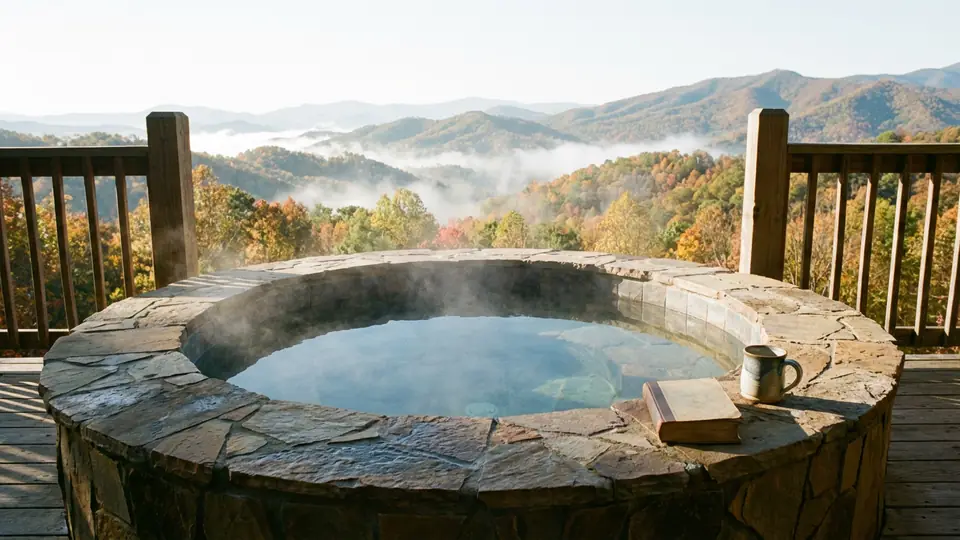
It is round, private, already warm. Steam lifts off the surface and dissolves into the evening air, which smells like cedar bark and limestone dust and, faintly, the wildflowers that line the gravel road. Fredericksburg's Main Street is three miles east. You could drive back for dinner. You could do nothing. The cabin has no opinion about your evening, and that absence of agenda is so unfamiliar it takes a moment to recognize as freedom.
You get in the tub.
The water is the same temperature as the tub at the Van Zandt. The jets work the same way. Your body is in the same position it would have been in on the fourth floor of a Rainey Street hotel. But the sky above you is so thick with stars that your partner laughs. Not at a joke. At the fact of them. You forgot they were there. You both did. In Austin the sky is orange, the color of a city that never fully darkens. Here the sky is black and silver and so deep it has texture.
The conversation in this tub is not the one that would have happened at the Van Zandt. That conversation would have been about tomorrow: brunch plans, museum hours, which bar to try. This one has no schedule. Your partner mentions a dream she had last week that she forgot until just now. Then silence for a while. Then you are telling her about a house you saw once on a drive through Vermont that you have never been able to find again, and you do not know how you got there from the dream, but that is how it works when no one is keeping time.
The water does not change. The temperature does not change. What changes is what you bring to it. In the city, you bring the city: its noise, its plans, its proximity to the next thing. In the Hill Country, you bring only what you carried in the car. Almost nothing. And enough.
You stay in the tub until your fingers wrinkle. The air is cool against your shoulders when you stand. Inside, the 1847 logs hold the warmth of the afternoon, and the bed is the kind of bed that people drove an hour for in 1847 too, though the road was worse and the tub had not been invented yet. You sleep without setting an alarm.
The Other Roads
The same Friday impulse, the same pulled drain, could have pointed the car south instead of west.
Fifty minutes from downtown Austin, the Adorable Cabin sits on ten acres outside Wimberley, where the Blanco River cuts through cypress-lined banks and the swimming holes have names that sound like folk songs: Blue Hole, Jacob's Well. The hot tub is on a private balcony that overlooks the acreage. The view is not the wide-open limestone of Fredericksburg but something smaller, greener, more enclosed. Pecan trees instead of live oaks. The sound of the river if the wind is right. Wimberley is the escape for the couple that does not want to be far, just away. You could be in this tub fifty minutes after pulling the drain at the Van Zandt, and the stars would be just as thick, and the evening just as quiet, but the quiet would be softer. River quiet has a pulse. Ranch quiet does not.
Or south on I-35 to New Braunfels, where the Gruene River Hotel sits along the Guadalupe in the historic Gruene district. The rooms have vintage clawfoot tubs with rustic wood finishes and the particular dignity of something that knows how old it is. The Guadalupe runs wide and slow past the hotel, and on Saturday nights the sound of Gruene Hall drifts through the trees: live music, two-stepping, laughter that carries across water. You do not have to go. You can lie in the clawfoot tub and let the sound come to you, Texas's oldest dancehall providing the evening's score from two blocks away. New Braunfels is the choice for the couple that does not want silence. They want a different kind of noise. Not the city's. The river's. The music's. The sound of a Texas evening that has been happening since before anyone thought to put a hotel here.
Three roads. Three versions of the same Friday. Three hot tubs with nothing outside the window but Texas, and each window frames a different Texas. The Hill Country is not one landscape. It is a collection of evenings, and each one answers the question differently.
On Sunday you drive back. The road reverses itself: oaks to open land, open land to Johnson City, Johnson City to Dripping Springs, Dripping Springs to the first traffic light, which feels like a small betrayal. Austin's skyline appears through the windshield. The same cranes, the same glass, the same city you love and will always come back to. But for the next few days the city sounds different. The noise that was invisible before the drive is audible now. The sky that was adequate before is smaller. By Wednesday you do not notice. On Thursday your partner texts you a link to a cabin you have not tried. You look at your calendar. Friday is open. The drain pulls again.