You hear the water before you see the city. A faucet turned to full, the hollow percussion of water striking porcelain and then, as the basin fills, the sound softening, thickening, becoming something closer to a pour. Steam climbs the tile. Through the window, Broadway's neon pulses in a line of pink and gold, but from here it registers only as color, not as sound. The glass holds. You are above the loudest street in the American South, and what you hear is water.
But that is not where the night started.
The night started the way Nashville nights always start. Loud. You stepped out of your hotel lobby and within two blocks the sound found you. Lower Broadway between 1st and 5th does not build gradually; it arrives. You round a corner and you are inside it. A corridor of open doors and competing bands, each venue's music bleeding into the next until no single song survives intact. What reaches your ears is something else entirely: a wall of rhythm, bass frequencies stacking, a pedal steel from one bar tangling with a drum fill from the one beside it. Not noise exactly. A texture. Dense and warm and a little absurd and completely specific to this half-mile stretch of asphalt.
The sidewalks are thick with people at ten o'clock. Couples, bachelorette groups in matching boots, a man in a cowboy hat who clearly bought the hat today. The air smells like fryer oil and hops and something sweet you cannot place. Maybe the praline shop on the corner. Maybe someone's perfume. Heat rises from the pavement even after dark; Nashville holds its warmth like a secret it is not ready to give up. You feel it through your shoes. You feel it on the back of your neck where your hair is pinned up and the humidity has won.
Your partner says something and you lean in. The words do not survive the distance between his mouth and your ear, but his expression does, and you laugh because the whole scene is a little ridiculous and a little wonderful. They coexist on Broadway the way the competing songs coexist: imperfectly, gloriously, without apology.
You pass the lit glass facade of a hotel that sits directly on the strip, its lobby visible from the sidewalk like a bright, quiet diorama behind the chaos. People are checking in with rolling bags, twenty feet from a man playing "Wagon Wheel" at concert volume. The contrast is so stark it almost reads as satire. But it is not. It is Nashville being Nashville. A city that has never been embarrassed by its own volume.
You stay on the strip long enough to feel it fully. There is a moment, somewhere past the third block, when a singer in one of the open-door bars hits a note that cuts through everything else. Clean and startling. The crowd noise drops for half a second, just long enough for the note to land, and then the roar rushes back in. You catch your partner's eye. Neither of you says anything. That is the moment you will carry out of Broadway. Not a venue name or a drink order but a single held note and the silence it carved into the noise.
And then you leave. You just know the strip has given you what it has, and some instinct pulls you north, away from the neon, toward the dark blocks above.
The first thing you notice is the volume dropping. Not all at once. Broadway does not have a border; it has a gradient. At 5th Avenue the music is still audible but thinned, like hearing a party from the next room. By 6th the bass frequencies have fallen away and what remains is treble, ghost notes, the memory of a song more than the song itself. Your footsteps become audible again. Your partner's voice returns to its normal register. You stop leaning in. You start talking.
The Tennessee State Capitol appears above the tree line, floodlit and pale against the dark sky. You did not expect it here, this close to the noise you just left. The grounds are empty. The lawn stretches uphill, groomed and quiet, an institutional silence almost aggressive after Broadway's generosity. A security light hums. Crickets pulse in the grass. The air is different here; you are on higher ground and the humidity has loosened its grip, or maybe you are just moving slower and noticing more. Nashville's night sky is not dark. It is a deep amber, the city's light reflected back by low clouds, and the Capitol sits inside that glow like something painted rather than built.
You walk along the iron fence and neither of you is in a hurry. The transition is the thing. The walk between Broadway and wherever you are going is not dead time; it is the hinge of the evening, the passage that lets the night change key. If you drove, you would miss it. If you took a rideshare, you would arrive at your hotel still vibrating at Broadway's frequency, and the room would feel like an interruption. But on foot, block by block, your nervous system recalibrates. The stimulation ebbs. The adrenaline settles into something warmer, slower. By the time you reach the hotel entrance, you are ready for what it offers, which is a different kind of evening entirely.
The lobby of The Hermitage Hotel at eleven o'clock at night is a study in deliberate quiet. The terrazzo floor catches the light from low sconces and returns it as a dull gleam, the color of old honey. The ceiling is high enough that sound dissipates before it can accumulate; a bellman's footsteps across the lobby do not echo so much as evaporate. There is no music. There has not been music in this lobby for a hundred years and the building wears that silence like a credential.
The front desk transaction is brief and warm. A nod, a key card, a recommendation you did not ask for but will remember. The elevator is paneled in dark wood and the doors close with a weight that registers in your chest, a gentle, percussive seal between the lobby's already-quiet air and the ascending hush above. Your partner presses the button and the car rises and neither of you speaks because the silence has become a shared project now, something you are building together without discussing it.
The hallway carpet absorbs your footsteps completely. The door to the room is heavier than you expect; you feel the mass of it in your shoulder as you push through. And then the door closes behind you and the click of the latch is the loudest sound you have heard in ten minutes.
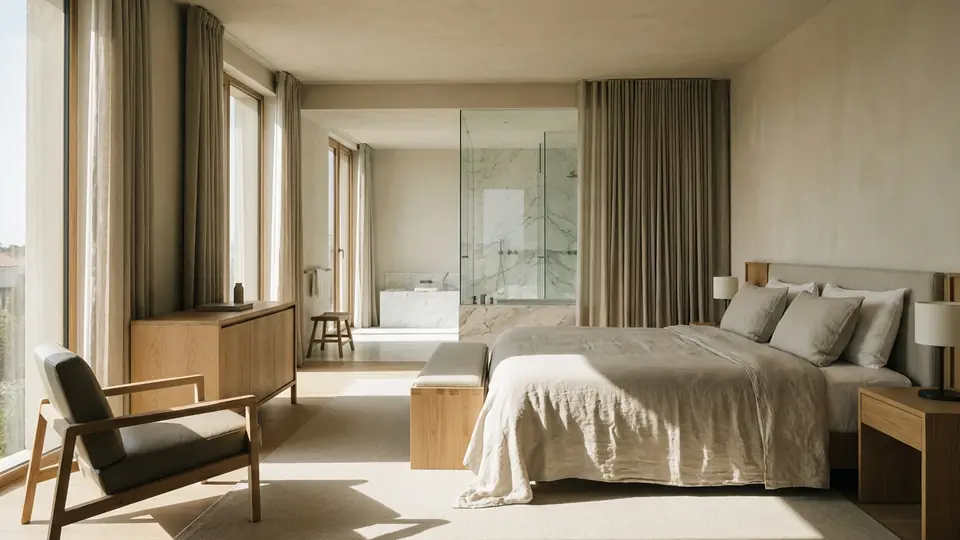
The room is dark except for the city. Nashville presses against the window in planes of amber and white, the Capitol directly ahead, lit from below, its columns throwing long shadows upward into the cloud-light. You do not turn on the overhead. You find the bedside lamp and give the room just enough light to navigate by. The bed is made with a precision that suggests someone cares about corners, and the pillows are absurd, stacked four deep, and you are not complaining. But you are not here for the bed. Not yet.
The bathroom is marble. Not the performative marble of a renovated lobby but the real thing, veined and cool, the kind that holds the cold even when the room is warm. The tub sits in the center of the floor, freestanding, oval, deeper than you expected. No jets, no chromotherapy, no Bluetooth. It is a bathtub, large enough for two, made of materials chosen to last a century, and it has lasted a century, and it will outlast your visit and every other. You rest your hand on the rim and the porcelain is cool.
You turn the faucet. The water runs hot almost immediately. You have been in hotels where it does not, and the difference between waiting ninety seconds and waiting zero is the difference between a ritual and an errand. Steam rises. The mirror fogs from the bottom up, your reflections disappearing by degrees. First your waists, then your chests, then your faces, until you are just outlines in a warm room filling with water and heat.
You get in. The water is almost too hot, which is the correct temperature, because the point of a bath at midnight is not comfort. It is surrender. The heat enters through your skin and finds the tension you did not know you were still carrying from the Broadway crowd, from the walk, from the low constant effort of being a person in a city. Those small contractions release. Your shoulders drop. Your jaw unclenches. Your partner's leg touches yours underwater and neither of you moves.
From the tub, if you turn your head, the window frames Nashville's nightline. The Capitol is still there, still lit, still deserted. Below it, you know, Broadway is still raging; the bars will not close for hours. But from here the city is silent and luminous, a diorama behind glass, and you are watching it from hot water in a room where the only sound is the occasional settling of the surface as one of you shifts. Not the bath instead of Broadway. The bath after Broadway.
No one plans this part. That is what makes it stay with you. The Broadway hours are researched, anticipated, budgeted for. You know which block to walk, which direction to head, roughly how the evening will unfold because a thousand people have described it online and they are all basically right. But no one describes the part after. The walk through the dark blocks. The lobby's silence after the strip's volume. The weight of a heavy door closing. The sound of water filling a tub that has been filling for a hundred years of guests who have done some version of what you are doing right now. That part is not in the itinerary. It lives in the gap between the trip you planned and the trip you remember.
The water stills. The steam thins. You have been in the tub long enough that the heat has become ambient, no longer a sensation but a state. Broadway's glow is still there in the window, pink and gold, but it has dimmed, or maybe your eyes have adjusted, or maybe it does not matter which. Your partner's breathing has slowed and so has yours and the distance between this moment and the noise you left is not measured in blocks anymore. It is measured in register. You were loud. Now you are quiet. Both were the night. Both were Nashville.
There are other versions of this evening. At the Four Seasons on the Gulch waterfront, the walk from the neighborhood's restaurants is shorter and the silence arrives sooner. The freestanding tub there faces the Cumberland River, and the view at midnight is the water itself, dark and reflective, a city seen not from above but from its edge. The Gulch has its own nighttime rhythm, quieter than Broadway, and the transition from dinner to room is gentler, a slow fade.
And then there is Belle Air Mansion, where Broadway never enters the picture at all. A historic estate with a fireplace and a freestanding tub, set back from the city, where the Nashville night is crickets and old wood and a quiet that has always been there.
But tonight, in this tub, in this room, the quiet is the kind that only exists because of what came before it. The note that cut through the crowd. The Capitol, lit and empty. The door that closed behind you with a sound like a period at the end of a sentence. The water has stopped moving. Neither of you has said anything for a while, and that is the point.