The Third Tasting
You are standing in a tasting room. Your partner is swirling something ruby in a glass, nodding at whatever the person pouring just said about soil composition. It is three in the afternoon. This is the third stop today, or the fourth. You have lost count because you stopped counting after the second, when you realized you were thinking about the room.
Not the wine. The room.
The claw-foot tub you noticed when you set your bags down. The window above it, or the skylight, or the door that opens onto a deck you have not used yet. You are thinking about hot water. About the moment, two or three hours from now, when the day ends and it is just the two of you and whatever is left in the bottle and the temperature of the air wherever you are.
Not the tastings. Not the reserve list or the cave tour or the pairing lunch that lasted two hours. The part that happens after. The part that starts when you sink into the water and the wine region stops being a destination and becomes a feeling on your skin.
Four American wine regions. Four evenings. Four versions of what hot water feels like when the landscape around it changes. The wine was different each time, but that is not what you will remember.
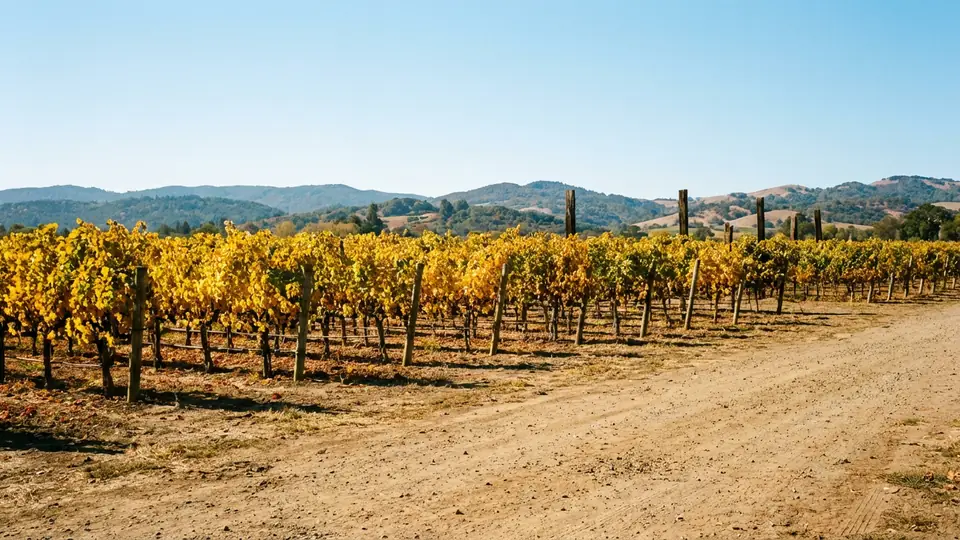
Napa: The Retreat
The fire at The Inn on First has been going long enough that the room smells like woodsmoke and clean linen, and the silence is so complete you can hear the logs settling.
This is a bed-and-breakfast on a residential street in Napa, a mile from the Wine Train tracks, and from the outside it looks like a house that belongs to someone's well-appointed aunt. Inside, the suite has a freestanding soaking tub in the bathroom, deep enough that the water covers your shoulders when you lean back. The porcelain is cool for exactly three seconds before the heat wins.
You spent the day in Calistoga and the valley floor, which means you spent the day surrounded by people. Couples posing with glasses against vineyard backdrops. Tour buses idling in gravel lots. The performance of Napa, where everything is arranged for the photograph, where even the casual lunch costs more than dinner in most American cities and the word "reserve" appears on every other menu.
None of that is in this room.
The tub faces a window that faces a garden, and the garden faces nothing. You can hear your partner breathing. You can hear water moving against porcelain when one of you shifts. Napa, for all its noise and spectacle, has a version of itself that is this quiet, and you have to leave the valley floor to find it. A B&B a mile from the tracks, where the loudest sound is a fire and the tub is not a feature but a recovery room.
Down the road in Calistoga, the Mount View Hotel offers the opposite translation. Its outdoor whirlpool sits where you can see the awnings of downtown, can hear a Friday evening starting in the bars and tasting rooms along Lincoln Avenue. The jets are strong. The air smells faintly of sulfur from the mud baths a block away. It is wine country with the volume still on, and some evenings that is what you want: the town humming around you while the water works the day from your legs.
But tonight you are at The Inn on First, and the volume is off. The fire pops. Your partner's eyes are closed. You realize you have not said anything in twenty minutes and neither of you has noticed.
You drink it in the hot water and understand for the first time why people come here and do not tell anyone.
Sonoma: The Land
The water at the Fairmont Sonoma Mission Inn is not the temperature you set. It is the temperature the earth set. The soaking tub in your marble bathroom is fed by a geothermal aquifer that has been hot since before anyone planted grapes in this valley. The same volcanic geology that makes the soil right for Pinot and Chardonnay also heats the springs that feed this inn. You are soaking, and the water touching your skin passed through the same rock that grew the wine you drank this afternoon.
Outside the window, fog is pulling itself across the Sonoma sky. One moment the oaks on the grounds were sharp against blue; now their edges have dissolved into grey, and the property, sitting on the edge of town near the golf course, surrounded by old oaks and too much land to feel crowded, has become a small world. The bathroom. The steam. Your partner's hand on the rim of the tub. A warmth that feels geological rather than mechanical.
Sonoma's day was slower than what came before it. A town plaza where someone had left a newspaper on the bench. Tasting rooms where the person pouring remembered your name from yesterday. A lunch that took ninety minutes because nobody was going anywhere. The evening is not escape. It is continuation.
The fog presses against the window. The water in the tub is the water of this place, heated by the same fire that sleeps beneath the vineyards, and the distinction between being at a hotel and being in Sonoma collapses. You are in the land. The land is warm. Your partner passes you a glass, and the wine in it grew a few miles from here, in soil that shares a geology with the water you are sitting in. You do not say this out loud. You do not need to. You just feel unusually, physically, part of where you are.
Finger Lakes: The Discovery
The lake is directly below you. Seneca, long and glacial, six hundred feet deep at its center, a body of water carved by ice ten thousand years ago that still holds the cold in its lower layers even in August. Your room is somewhere on the western shore, up a hill, through trees you cannot name because they are not the oaks and eucalyptus of California. The tub is by the window, or on the deck; the point is that the lake is there, enormous and dark, and the sky above it is doing something you have never seen it do over a vineyard.
It is late evening. The temperature dropped fifteen degrees in the last hour. You were not expecting this. You were not expecting any of it: not the Riesling at lunch, sharp and mineral and nothing like what you drink at home; not the winery that was a barn with a hayloft and a golden retriever asleep on the porch; not the gorge you drove through on the way here, where the rock walls were layered like a cross-section of the earth and the water at the bottom was moving fast.
The tub is hot and the air is cold and the combination is what the Finger Lakes do to your body: a negotiation between comfort and exposure. Your skin cannot decide. You sink lower. Your partner, who found this place on a blog or a friend's offhand suggestion, is looking at the lake with an expression you recognize. It is the expression of someone who has stumbled onto something and is not ready to share it yet.
There are no tour buses. No reserve lists. No couples posing. The tasting room today had seven people in it, and one of them was the winemaker's daughter doing homework at a corner table. The wine was cold-climate and honest, made by people who grow grapes in a place where growing grapes is difficult, and the difficulty was in the glass.
In the tub, the cold air hits your chest every time you sit up. The lake reflects nothing because it is too dark, and the stars are the kind you forgot existed. Your partner reaches over the edge of the tub and comes back with a glass of the Riesling you bought at the barn. It is so cold it fogs the glass. You drink it in the hot water and understand, finally, why people come here and keep it to themselves.
Willamette: The Weather
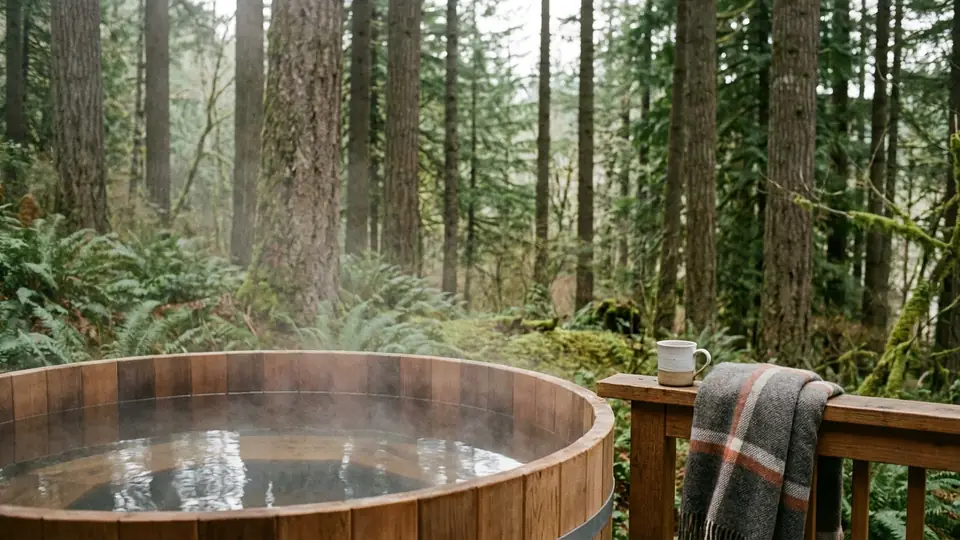
It is morning. It is raining. It has been raining since before you woke, a steady Oregon rain that does not pound or sweep but continues, the way a river continues, without effort or interruption. The cottage you are in sits between Dundee and McMinnville, in the fold of the Willamette Valley where the Pinot Noir vines grow in red volcanic soil and the hills on both sides are so green they look backlit.
The tub is under a skylight. The rain is hitting the glass above you, and you can see each drop arrive and slide, and the sound it makes is not dramatic but persistent, a white noise that is not white at all but layered: rain on glass, rain on the roof, rain on the leaves of whatever is growing against the side of the cottage, rain on the gravel path outside.
You got in the tub twenty minutes ago. Or forty. The morning has lost its edges. Your partner is beside you, half asleep, one hand on your knee under the water, and the steam rising from the surface meets the cold air at about the level of your chin, so your face is cool and your body is not, and this division between the two temperatures is the most precise sensation you have felt in months.
This is Pinot Noir country, which means it is rain country, which means the weather is not an inconvenience but a condition of the place, like the fog in Sonoma or the cold in the Finger Lakes. The difference is that here, the weather does not come and go. It stays. It is in the tub with you. The rain on the skylight is so steady that it becomes the baseline, and everything else, your breathing, the small sounds of the water, the occasional car on the road outside, registers as variation from that constant.
You are not doing anything. The tastings yesterday were quiet: small rooms, serious winemakers, Pinot Noir that tasted like this valley and no other. But the tastings were yesterday. This morning, there is the tub. The rain. The green through every window. Your partner's hand. The absence of any plan.
The rain is not something you wait out; it is the atmosphere the room was designed for, and in the tub, beneath the skylight, the rain falling on the glass above and the heat rising from the water below, you are inside the weather in a way that you have never been inside a landscape before. Not looking at it. Wearing it.
The Fingertip
Four wine regions. Four evenings. The same two people.
You remember the fire in Napa and how the silence felt earned. You remember the lake in the Finger Lakes, black and enormous, and the cold that made the heat feel like something you had to fight to keep. You remember the rain in Willamette and the morning that had no edges.
The wine was different each time. The grapes, the glass, the person who poured it. But that is not what you carry. What you carry is the water. The way the air felt against your wet shoulders. Whether the sound outside was silence or fog or wind off a glacial lake or rain that would not stop.
You look at your fingertip. Pruned. Deep wrinkles from the water that you did not notice forming. You do not know how long you have been in the tub. The glass on the ledge is empty. Your partner has not moved. The air outside the water touches your hand, whatever temperature it is, wherever you are, and it is the last thing you feel before you decide to stay a little longer.